Voyeurism and blackmail
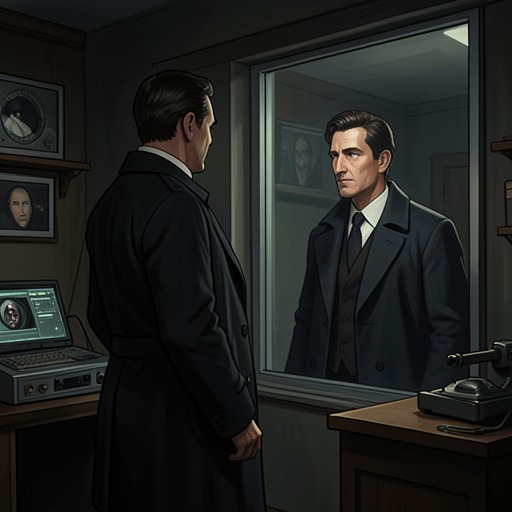
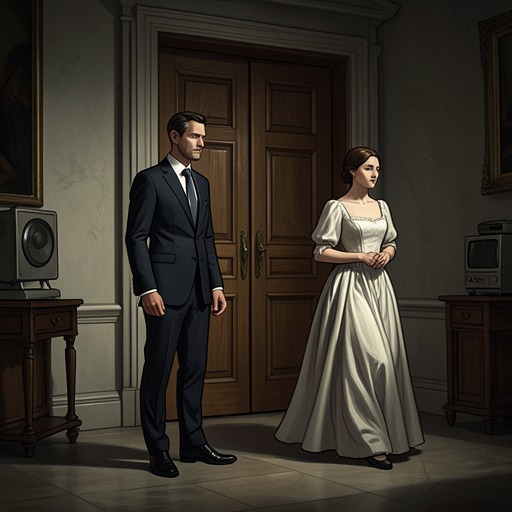
The Big SleepVoyeurism and blackmail form an economy of looking, recording, and threatening in The Big Sleep. Arthur Gwynn Geiger’s hidden camera makes Carmen Sternwood’s private image a saleable object; the photograph then becomes leverage against Vivian Regan and the wider Sternwood family. Around that scheme, Geiger’s illicit book business, Joe Brody’s attempt to take it over, and Marlowe’s decisions about what to tell the police show how private exposure can become both a source of profit and a means of controlling which version of events survives.
The business of exposure
Geiger’s operation joins illicit books to blackmail rather than treating them as separate ventures. Marlowe discovers that the books are heavily bound volumes with dates stamped in and out, evidence of a lending library rather than a conventional shop stock. The trade is public-facing, yet Marlowe’s inference that it must enjoy substantial protection points to the network required to keep such a racket operating openly.
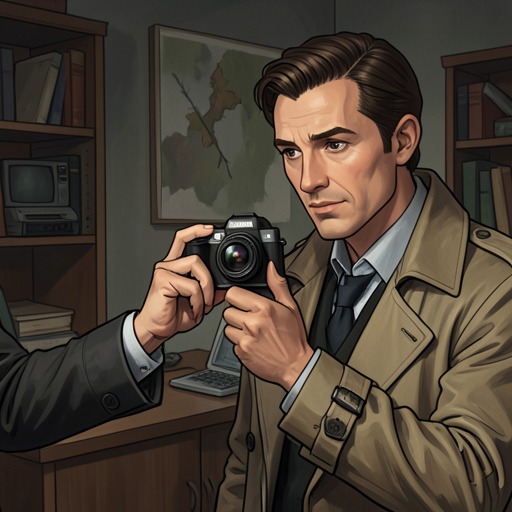
The concealed camera gives Geiger’s business another means of extracting value. At Geiger’s house, Marlowe finds a camera disguised as a carved object and aimed at Carmen, who has been drugged and is unaware of her surroundings. The blackened flash bulb helps account for the flash Marlowe had noticed, while the camera establishes that the scene was not merely private: it was arranged to produce an image that could be retained and used. Geiger’s death leaves that apparatus and its evidence available to others.
From image to threat
The photograph later placed before Marlowe is a small, specific object with a much larger reach. Vivian has received it in a messenger-delivered envelope addressed to her at 3765 Alta Brea Crescent; the office stamp records dispatch at 8:35 a.m. The image shows Carmen in the high-backed chair at Geiger’s house. Its blank reverse offers no explanation or signature, but the demand supplies the purpose: five thousand dollars for the negative and remaining prints, with payment required that night or the materials would go to a scandal sheet.
The threat is sharpened by an accompanying claim about police involvement. Vivian reports that the caller warned of a police jam and suggested that, without quick action, she might have to communicate with her sister through a wire screen. She does not know what the alleged trouble is. That uncertainty is part of the leverage: the blackmailer couples the image’s reputational danger with the possibility of criminal consequences, while withholding enough information to make the threat difficult to assess.
Competing claims to the racket
After Geiger’s death, Joe Brody seeks control of the business and its assets. Marlowe calculates the potential scale of the lending operation from a coded list of about five hundred names and an estimated stock of five hundred books, including volumes already out on loan. Assuming half the list could be used and rentals averaged at one dollar, he puts the possible gross revenue at $125,000 while stressing that the calculation is an estimate. He presents the figures to Brody as a reason the racket is worth taking over, not as a verified accounting.
Marlowe also accuses Brody of killing Geiger to obtain the operation. His reconstruction is that Brody took the photographic plate from the camera, later returned to hide Geiger’s body, and used the interval to tidy up the books before the authorities knew they had a murder to investigate. The evidence places the racket’s commercial assets and the murder’s physical evidence in the same chain of attempted control: the books could be transferred, while the camera plate and concealed body could delay discovery and preserve the threat’s usefulness.
Public accounts and private omissions
The scandal does not remain confined to private bargaining. Bernie Ohls tells Captain Cronjager that a chauffeur’s body has been recovered from a car lifted out of the Pacific Ocean off Lido Pier, connecting the family’s blackmail trouble to a death under investigation. In his account, Marlowe had played matters close to the vest. When Marlowe then recounts events to the officials, he leaves out Carmen’s visit to Brody’s apartment and Eddie Mars’s visit to Geiger’s house, while telling the rest as it happened.
That selective account makes information itself a form of protection. The novel distinguishes between what Marlowe knows, what he gives the police, and what the authorities can turn into an official story; the omissions are consequential because they keep particular connections out of his report. In a separate conversation, Marlowe says Geiger was trying to blackmail General Guy Sternwood, but Eddie Mars disputes that explanation: he describes Geiger as using apparently legal promissory notes against many people, testing whether a target could be frightened into yielding and abandoning the effort when the gamble failed. The account complicates the idea of a single family-centered plot, presenting blackmail as a repeatable method applied wherever fear might produce a return.
A fragile hold on evidence
A later conversation about a blonde woman’s role in Geiger’s operation continues that uncertainty. A speaker calls her a shill for Geiger and says he will discuss the matter with Eddie Mars; when asked how much the peeper was tapped for, the answer is two hundred. The exchange suggests that the people around the racket are still bargaining over what the woman did and what someone was paid, even after Geiger’s death. It does not settle every participant’s responsibility, but it shows how the business’s personnel and payments remain subjects of negotiation.
The landscape around the Sternwood fortune gives the racket a broader frame. From the estate, the old oil field that made the family rich is still visible below the terraces and high iron fence: much of it has become public park, while a small portion continues to produce. The separation is physical but incomplete; the family has moved uphill, yet its wealth still looks back toward its source. The novel’s blackmail plot similarly depends on the persistence of what should have been private: images, records, and old connections remain available for someone to exploit. Marlowe can recover or withhold pieces of evidence, but he cannot make the underlying system of exposure disappear.